






 Healthcare Organizations Reduce Supply Costs
How Healthcare Organizations Reduce Supply Costs
10 Proven Strategies to Improve Purchasing Efficiency, Strengthen Financial Visibility, and Reduce Supply-Related Expenses
For many healthcare organizations, supply expenses represent one of the largest controllable operating costs. From medical and surgical supplies to office products, vaccines, pharmaceuticals, laboratory materials, and purchased services, supply-related spending has a significant impact on financial performance.
As reimbursement pressures continue to increase, healthcare organizations are seeking ways to reduce costs without compromising patient care, operational efficiency, or clinical outcomes.
The good news is that reducing supply costs is often less about cutting spending and more about improving visibility, standardization, and purchasing discipline.
Where Healthcare Organizations Lose Money
Many organizations are surprised to discover that rising supply costs are often caused by operational inefficiencies rather than vendor pricing. Common challenges include:
 Decentralized purchasing across multiple locations
- Off-contract purchasing
- Duplicate vendors
- Lack of spending visibility
- Manual ordering processes
- Overstocked inventory
- Emergency purchases
- Limited approval controls
- Unused or expired inventory
- Inconsistent product standardization
Without visibility into purchasing activity, organizations often struggle to identify where opportunities for savings exist.
How ACXSS Helps Healthcare Organizations Reduce Supply Costs
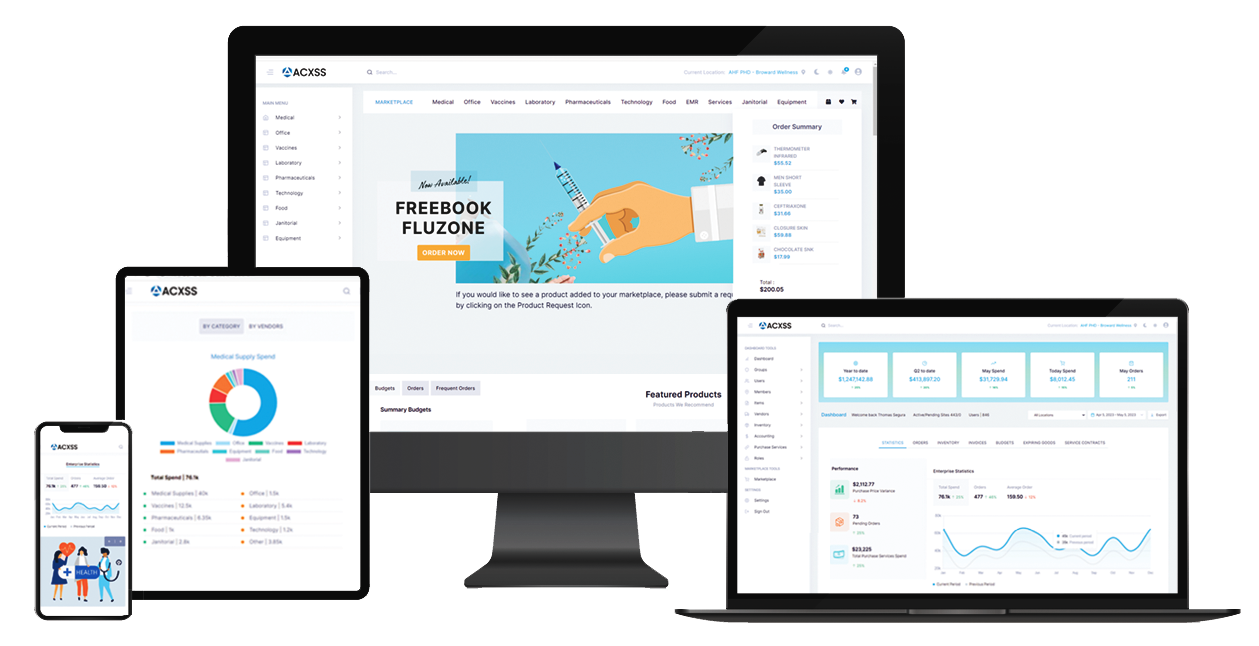
ACXSS provides healthcare organizations with a centralized platform for managing purchasing, inventory, invoice automation, approvals, analytics, and operational spend management. Key capabilities include:
- Centralized Purchasing
- Spend Analytics & Reporting
- Inventory Management
- Budget Controls & Approvals
- Invoice Automation
- Vendor Management
- ERP & Accounting Integrations
- Predictive Ordering through ACXSS Sentinel
By improving visibility and control across the entire purchasing lifecycle, ACXSS helps healthcare organizations identify savings opportunities, improve operational efficiency, and make more informed purchasing decisions.
Strategy #1: Increase Spend Visibility
You cannot control what you cannot see. One of the first steps toward reducing supply costs is gaining visibility into organizational spending across all locations, departments, vendors, and categories.
Organizations should be able to answer questions such as:
- How much are we spending?
- What are we buying?
- Who is buying it?
- Which vendors are receiving the most spend?
- Are we purchasing on contract?
- Are costs increasing or decreasing over time?
Centralized spend analytics allow leadership teams to identify trends, uncover inefficiencies, and make data-driven purchasing decisions.
Strategy #2: Standardize Purchasing Processes
Many healthcare organizations allow locations, departments, or individual employees to purchase supplies independently. While convenient, this often leads to:
- Product variation
- Vendor fragmentation
- Pricing inconsistencies
- Reduced purchasing leverage
Standardizing purchasing workflows helps organizations:
- Improve compliance
- Consolidate purchasing volume
- Strengthen vendor relationships
- Reduce unnecessary spending
Organizations that standardize purchasing often gain better control over costs while maintaining operational flexibility.
Strategy #3: Reduce Off-Contract Spending
Negotiated contracts frequently provide pricing advantages, rebates, and purchasing incentives. However, organizations often discover that employees purchase products outside of approved agreements.
Off-contract purchasing can result in:
- Higher prices
- Lost rebates
- Reduced contract compliance
- Increased vendor management complexity
By directing purchases through approved vendors and contract pricing programs, organizations can capture savings that may already be available.
Strategy #4: Consolidate Vendors
Over time, organizations often accumulate multiple vendors supplying similar products. Vendor consolidation can help:
- Increase purchasing leverage
- Improve pricing negotiations
- Reduce administrative workload
- Simplify invoice processing
- Strengthen supplier relationships
Fewer vendors can also improve reporting accuracy and spending visibility. The goal is not necessarily to eliminate vendors, but to strategically align purchasing with preferred suppliers whenever possible.
Strategy #5: Improve Inventory Management
Inventory can quietly become one of the largest sources of waste. Common inventory-related challenges include:
- Overstocking
- Expired products
- Duplicate inventory across locations
- Stockouts
- Emergency purchasing
Effective inventory management helps organizations:
- Maintain appropriate inventory levels
- Improve product utilization
- Reduce carrying costs
- Minimize waste
- Improve replenishment accuracy
Organizations that actively monitor inventory usage often uncover significant savings opportunities.
Strategy #6: Automate Purchasing Approvals
Many organizations have limited controls over purchasing activity. Approval workflows help ensure purchases are:
- Necessary
- Budgeted
- Properly authorized
- Aligned with organizational policies
Approval automation improves accountability while reducing unnecessary or unauthorized spending.
Strategy #7: Use Data to Identify Savings Opportunities
Healthcare organizations generate large amounts of purchasing and financial data every day. The challenge is transforming that data into actionable insight.
Spend analytics can help organizations identify:
- Price variances
- Purchasing trends
- Vendor performance
- High-growth spend categories
- Consolidation opportunities
- Budget variances
Data-driven decision making allows organizations to focus improvement efforts where they can have the greatest impact.
Strategy #8: Eliminate Manual Invoice Processing
Supply cost management extends beyond purchasing. Manual invoice processing can create:
- Administrative overhead
- Duplicate payments
- Approval delays
- Matching errors
- Lost visibility
Invoice automation helps organizations:
- Improve accuracy
- Reduce processing costs
- Accelerate approvals
- Strengthen financial controls
- Increase visibility into spending activity
Reducing administrative expenses can produce meaningful savings alongside purchasing improvements.
Strategy #9: Implement Predictive Ordering
Many healthcare organizations still rely on manual ordering decisions. This often leads to:
- Overstock situations
- Inventory shortages
- Rush orders
- Inconsistent purchasing patterns
Predictive ordering solutions use historical purchasing activity, inventory data, and utilization trends to help organizations order the right products at the right time.
Benefits include:
- Improved inventory accuracy
- Reduced waste
- Fewer stockouts
- Better purchasing decisions
As healthcare supply chains become increasingly complex, predictive technologies play a larger role in cost containment.
Strategy #10: Create Accountability Through Reporting
Organizations that consistently reduce supply costs typically establish clear accountability. Leadership teams should regularly review:
- Supply expense trends
- Budget performance
- Vendor spending
- Purchasing compliance
- Inventory utilization
- Approval activity
When stakeholders have access to meaningful data, organizations are better positioned to manage costs proactively rather than reactively.
Supply Cost Reduction Is a Continuous Process
Reducing supply costs is not a one-time initiative. The most successful healthcare organizations continuously evaluate purchasing patterns, inventory performance, vendor relationships, and operational processes to identify new opportunities for improvement.
Organizations that combine visibility, automation, analytics, and purchasing discipline are often able to achieve meaningful cost savings while maintaining high levels of operational performance and patient care.
Frequently Asked Questions
What is the biggest driver of supply costs in healthcare?
While pricing is important, many organizations find that lack of visibility, inconsistent purchasing practices, inventory waste, and off-contract spending contribute significantly to rising supply costs.
How can healthcare organizations reduce supply expenses?
Organizations can reduce supply costs through improved spend visibility, purchasing standardization, inventory management, vendor consolidation, approval controls, and automation.
Does inventory management help reduce supply costs?
Yes. Effective inventory management helps reduce waste, prevent stockouts, improve utilization, and lower carrying costs.
What role does technology play in supply cost reduction?
Technology provides visibility, automation, analytics, and predictive insights that help organizations make better purchasing and inventory decisions.
Ready to Learn More?
Discover how healthcare organizations reduce supply costs through improved purchasing visibility, inventory management, vendor consolidation, invoice automation, analytics, and predictive ordering.
Schedule a demonstration today to learn how ACXSS helps organizations strengthen financial oversight, improve operational efficiency, and make more informed purchasing decisions.
SEO Metadata
SEO Title
How Healthcare Organizations Reduce Supply Costs | 10 Proven Strategies
Meta Description
Learn how healthcare organizations reduce supply costs through purchasing visibility, inventory management, vendor consolidation, invoice automation, analytics, and predictive ordering.
Keywords
Primary Keywords
- Healthcare Supply Cost Reduction
- Healthcare Spend Management
- Supply Chain Cost Savings
- Healthcare Purchasing Optimization
- Inventory Management for Healthcare
Secondary Keywords
- Healthcare Procurement Software
- Spend Analytics for Healthcare
- Vendor Consolidation Strategies
- Invoice Automation for Healthcare
- Predictive Ordering Solutions
- Healthcare Operational Efficiency Tools
High-Intent Search Phrases
- How to Reduce Supply Costs in Healthcare
- Healthcare Supply Cost Reduction Strategies
- Healthcare Spend Visibility Tools
- Healthcare Inventory Management Solutions
- Healthcare Vendor Consolidation Benefits
- Invoice Automation for Healthcare Organizations
- Predictive Ordering for Healthcare Supply Chains